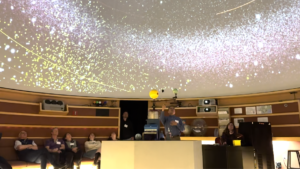
Join us for an evening of learning and conversations with UW astronomers!
UW Planetarium, 3910 15th Ave NE, Seattle WA 98195 (Directions) PAA A114, first floor.
REGISTER TODAY
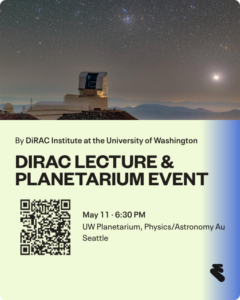
We’re at the brink of a new age of survey-driven discovery in astronomy. Where before we could only study a handful of objects at a time, new detectors, algorithms, and telescopes will soon allow us – and the entire world – to monitor billions.
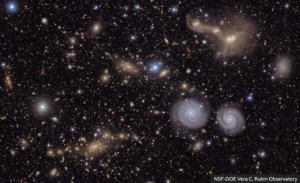
The Vera C. Rubin Observatory’s Legacy Survey of Space and Time (LSST), the most comprehensive optical astronomical sky survey ever undertaken, will obtain panoramic images of the night sky every clear night for ten years, starting this year. The resulting 60 petabytes of imaging data, essentially a digital color movie of the night sky, will include about 20 billion galaxies and a similar number of stars, and will be used for investigations ranging from cataloging potentially dangerous near-Earth asteroids to fundamental physics such as characterization of dark matter and dark energy.
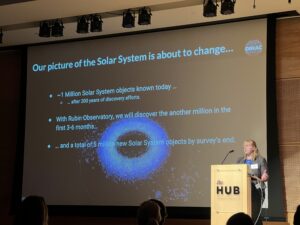
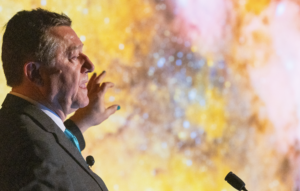
Prof. Ivezic will describe scientific goals behind this project, showcase its early data, and discuss remaining fine tuning of the Observatory in order to start LSST and Sarah Greenstreet will share the insights on the ultra-fast rotators, which are among the first asteroid discoveries form Rubin Observatory.
We hope you can join us for this enriching experience!
P R O G R A M
S P E A K E R S
Željko Ivezić is a professor of astronomy at the University of Washington, Head of Rubin’s Legacy Survey of Space and Time and former Director of Rubin Observatory Construction. Željko’s scientific interests are in detection, analysis and interpretation of electromagnetic radiation from astronomical sources, with emphasis on large datasets and machine learning.
Sarah Greenstreet is a tenure-track assistant astronomer at the NSF National Optical-Infrared Astronomy Research Laboratory (NOIRLab) and an affiliate assistant professor in the University of Washington’s Department of Astronomy. She is also a member of the Rubin Observatory Community Science Team and has served as the Lead for the Rubin Observatory Solar System Science Collaboration’s Near-Earth Objects and Interstellar Objects Working Group for the past seven years. Prof. Greenstreet’s research program broadly focuses on orbital dynamics, characterization, and impacts of small bodies across the Solar System, with a particular focus on the rarest and most unusual asteroids. To learn more about her research, please visit her website: www.sarahgreenstreet.com.